Actual qns to ask;
Answer for hw2, q4.1? (isnt it correct? Saying any number of even, and an optinal odd)
Hw2: Q3.3:
Hw2: Q3.4:
Hw2: 2.2
Hw2: 2.3
Homework qns:
MCQ (done)
- set of all subsets of an empty set
- vs
- produces a set of pairs, eg.
- Produces a set of strings eg. (note they aren’t in a set tgt).
- If A has then
- inventor of latex: Donald Knuth
- subset of regular langauge isn’t guarentee to be regular (expand with all types of operations..)
- ambiguous def: CFG may be ambiguous if its possible to get a different parse tree but same result string
Hw1 (Easy)
Set theory: (done)
- , all elements in not in
- : multiply all elements tgt (skippable)
- (Powerset): All subsets of including empty set. Always ,
Build DFA
- L3 = {w | w starts with an 1 or ends with a 0}, Σ = {0, 1}.
- L2 = {w | w has at most two occurrences of the symbol b}, Σ = {a, b}.
Proof via Induction (done)
- Base Case (minimum value)
- induction step step
- then if true for must be true for
Hw2 (hard)
Pumping Lemma Hw2 q6 (DONE)
pumping lemma for other example
Esentially we want to prove that p +l > p and thus breaks our original properties.
Assume regular language A , there must be some length p s/t
- s is any string in A of at least p length
- s can be divided into 3 pieces: xyz:
- for i>0, , i++
L1={w∈{0,1}∗∣ every prefix of w has at least as many zeroes as ones}
Towards contradiction, assume D regular. Consider sample string
Which has length 2p, thus is in s. We know that cannot be greater than p, and thus is confined to 0 like so:
Consider if we pumped i=0, we would see an uneven amount of 0’s compared to ones which thus disproves the langauge can be regular.
NFA build
Let Σ = {0, 1}. Give state diagrams for NFAs that recognize the following languages.
(i) L1 = {w | w contains two consecutive 1s or w contains no 0s}.
(ii) L2 = {w | w = w1w2 … wn such that wn−3 = 0 and wn−2 = 1}.
PowerSet construction
Qns 2.2 and 2.3
GNFA construction (DONE)
(q5 hw2). GNFAs are NFA’s with regex symbols in them. We use them to take out states to eventually reach one symbol.
- make new start and end state
- rip out intermediate states
Regular Expressions (DONE)
Eg. some w | w as some binary number, accepts when divisible by 2
Either:
aka any number of chars then a 0, or any number of 0’s or 1’s then a 0
Hw3
PDAs (done)
Defined via
- set of states
- — input alphabet
- — set of pushdown symbols (which can be pushed and popped from the stack) (isnt this just sigma with $ appended?)
- : defined as (current_state,input,popped_symbol) (end_state,symbol_pushed):
- — start state
- — accept states
example:

Give a context-free grammar that generates L(P_3) (DONE)
CFG to CNF? (DONE)
CNF: CFG that must follow the form:
- Add a new start state pointing to original start state
- remove all states (go upward one level to replace using
|) - Tidy all leftover forms that don’t match the given eg. becomes and
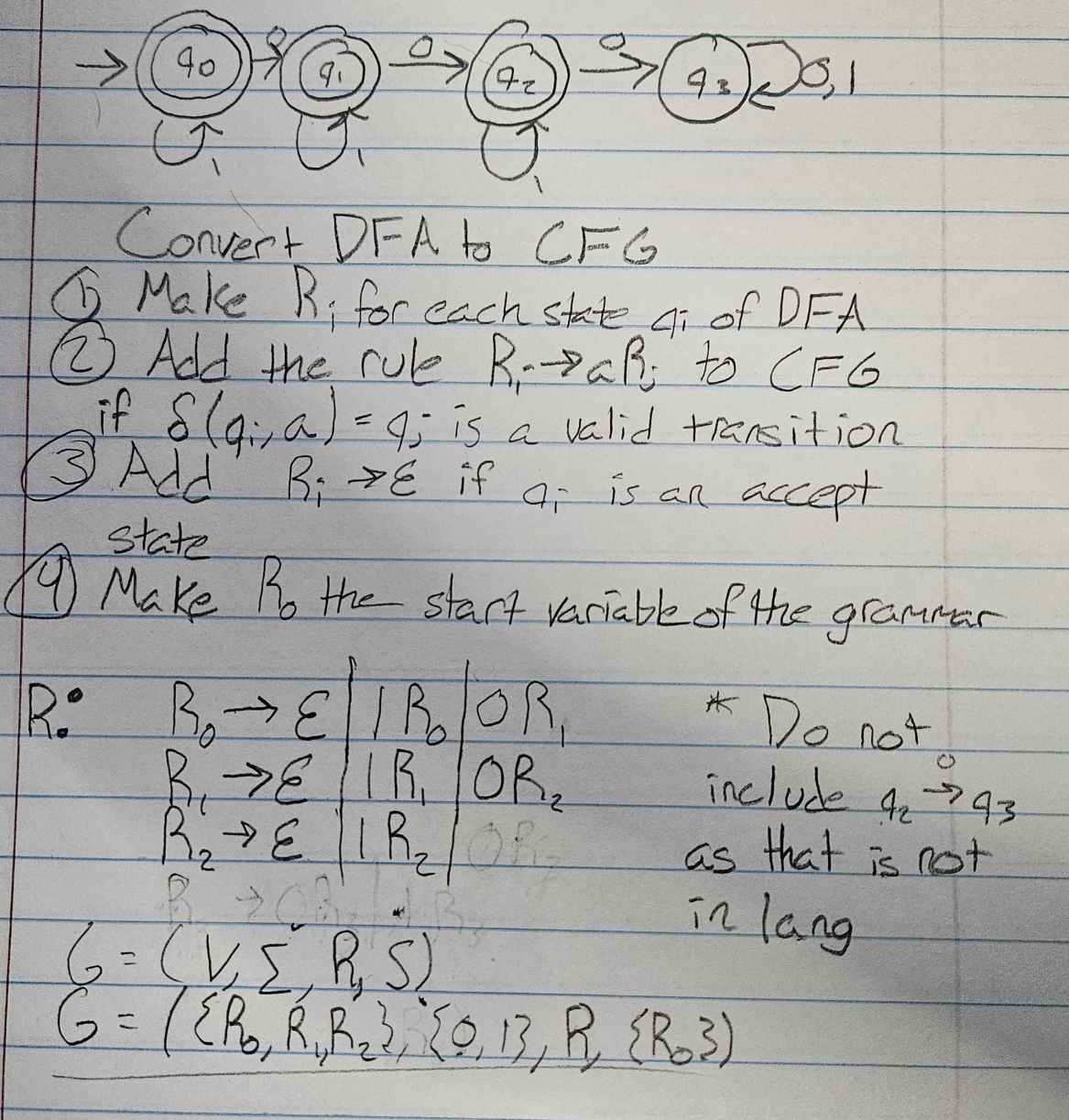
Regualr Grammer from Language L (DONE)
. Find a regular grammar that generates the language :
- Generate DFA from L
- Replace all nodes with
- eg.
- Then continue for ONLY accepting states
Hw4
PDA construction
Hw5
Decidability
hw5 q2
Closure in P (DONE)
For all but , we generate 2 TM’s which run in polynomial time. With an input m, split non-deterministically into a,b. Then feed a,b into both tape TA TB.
- → A ^ ! B → (A=T,B=F) → T ^ ! F → T ^ T → T
- → A ^ B
- → A v B
If → A ^ B, then we have 2 inputs, a,b. We cannot split unlike above non-det and instead only take the inputs
Decidable languages
Config & description of TM
(I still don’t understand concat vs union proofs..)
3 ways 2 describe TM: Formally, implementation, high lvl.
Formal: Implement entire diagram + states of TM, implmentation, talkj about algo in mmore detail
High-level description of TM , decides language , concatenation of the decidable languages and : s/t
We take the same approach we did with closure properites, creating 2 TMs, TA, TB. Take string w run thru all possible combos of splitting it into x,y. Feed x, y respectively into TA, TB. If both accept, accept, else reject if no combos accept.
- On input , take all possible combos of into xy. ? have ways to split into two parts.
- Feed each one of the two parts to the respective TMs for and .
- If both and accept, accept
- Otherwise try another split.
- If all splits have been considered and in none of them both and accepted, then reject.E
From announcement
Post Correspondence Problem(Done)
is undecidable. We’re given a set of fractions, want to find where the string of the concatanated numerators is the same as concat denom.
asymptotic complexity: Big-Oh, little-Oh, Big-Omega, little-Omega, Theta. (Done)
-
Worst case complexity, slower/= to g(n)
- must be slower than g(n)
-
Best case complexity ( g(n))
- must be faster than g(n)
-
exact complexity (in all cases)
-
. TRUE (drop constants)
-
TRUE but f(n) != o(f(n))
-
. TRUE (both are ^n)
-
. FALSE (take limit for n/2n → 1/2 0)
-
. TRUE (lim again → 2^n / 3^n → 0)
-
The formula is satisfiable. FALSE (truth table or skill issue..)
classes P and NP are? (Done)
- P: polynomial time O(n^k) (solvable problems)
- NP non-deterministic P (unsolavable)
- P vs NP means if problem takes P on a non-deterministic TM, then one can build a deterministic TM which would solve the same problem also in polynomial time.
Turing Machines (Done)
Decider if will ! infinite loop for finite string.
Formal Defition (DONE)
7 tuple, augmented FA:
- Q: set of states
- : inp alphabet
- : Tape alphabet, as many symbols can read frm inp + a few more (inc blank symbol) where
- Reads some state + inp symbol, will produce new state as result
- start
- accept
- Reject, can never be same as accept
Proving undecidable problems
In cheat sheet
- PL
- Set theory
- MCQ from midterms
Small items (Done)
- A Hamiltonian path goes through every node exactly once
- No one knows whether HAMPATH is solvable in polynomial time.