Turming Machine TM
FA vs TM?
- r/w can -mv L/R (think FA singly linked list, TM doubly)
- TM can write, this is BIG. Previous FA/PDA (any automata) couldn’t write!
- infinite tape length
- Special states (eg. accept/reject) take effect immidetly
TM Formal Defition
7 tuple, augmented FA:
- Q: set of states
- : inp alphabet
- : Tape alphabet, as many symbols can read frm inp + a few more (inc blank symbol) where
- Reads some state + inp symbol, will produce new state as result
- start
- accept
- Reject, can never be same as accept
Levels of descriptions of TMs (tm remarks)
We have 3 ways of describing TMs. In each we use the following example: Where w is treated as a string of 0’s and 1’s and # is some seperator symbol (so its string w # string w).
Formally:
Using our formal defition above, where is given via drawn diagram (see hw).
Implementation Description:
In english describe how head moves, how data stored on tape. Do ! need to give transition func details
Solution
Starting from the
High-Level:
Psudeo code ignoring implementation. No need to expalin how head is moved or tape managed.
Solution:
for being position of unique # character. for each i < k check if the values at tape[i] equals tape[i+k]. If equal continue, else reject.
Finally when we hit the end of i+k, if there are more indexes after that reject, else accept.
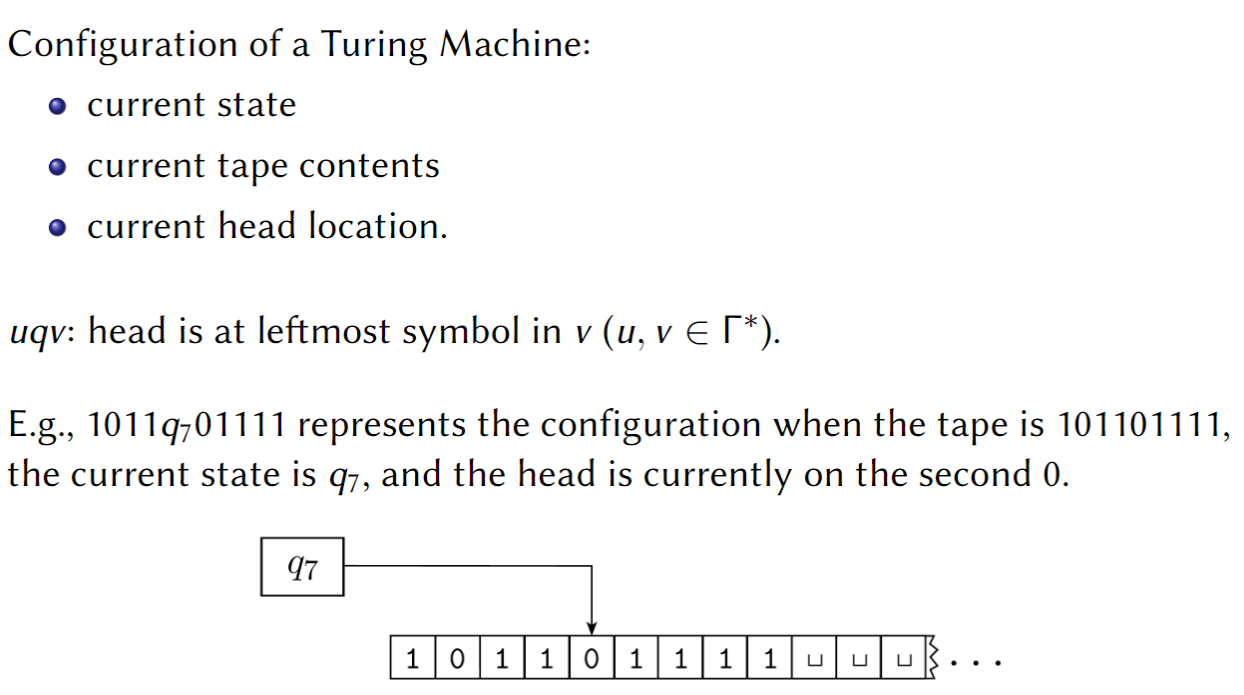
Config of turning mch (Will be on midterm+Final!!!)
Must know 3 things at all moments:
- Current state (position on tape)
- tape contents (entire infinite stack)
- Current head loc (value at position of tape)
Can think like hashset, should know key + value at all times and
Start config of M on inp w: w
For slide 11: Delta func says if state read b, then replace b with c and mv head left. We then add the L to show
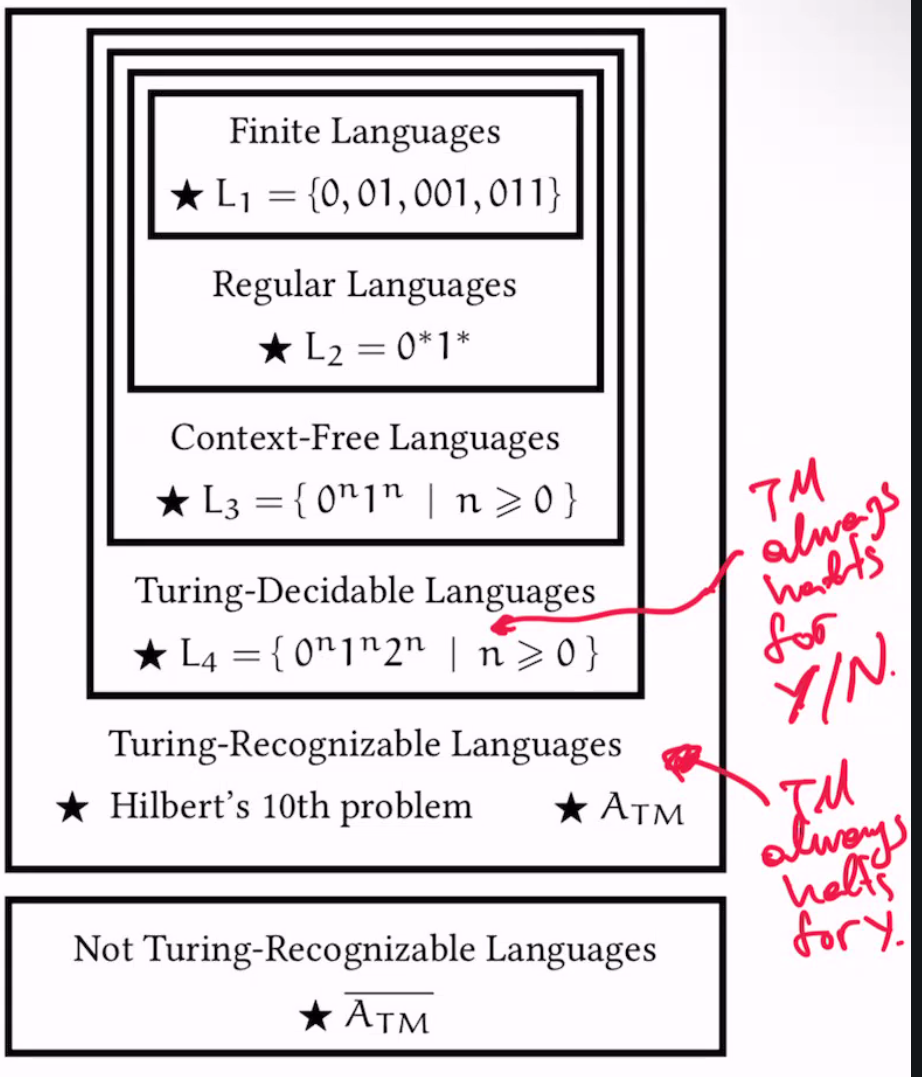
Turing recognizable vs decidable langauge
- Decidable: Assume determinicst TM, TM accept if inp belongs to language. both yes & no are always answers by the TM
- Recognizable: Situation whr TM always holds for YES ans, if
wbelong to lang? M always accept,
Ex 3
Language consits of al 0s, which length = pow 2. so for our psudeo code we js hv str.len % 2 == 0? In that sense it’s a bitwise OR, us looking @ the last binary digit 0 ? 1 : false,true
In this sense, we can just do the same thing by
Thinkg hw u wuld solve using psudeo code! Once find? translate back 2 a TM.