Discrete Random Variablrs dpqr
todo when would I use each one?
| Distribution | PMF/PDF (d*) | CDF (p*) | Quantile (q*) | Random (r*) |
|---|---|---|---|---|
| Normal | dnorm | pnorm | qnorm | rnorm |
| Binomial | dbinom | pbinom | qbinom | rbinom |
| Geometric | dgeom | pgeom | qgeom | rgeom |
| Hypergeometric | dhyper | phyper | qhyper | rhyper |
| Poisson | dpois | ppois | qpois | rpois |
Binom functions
Prob btwn 2 vars of a TRUE/FALSE outcome
- p=prob of susc
- k= # trials
p&dbinom table
- k = goal
- n=
- p=
| Probability you want | R expression |
|---|---|
| (lower tail) | pbinom(k, n, p) |
pbinom(k-1, n, p) | |
1 - pbinom(k-1, n, p) | |
1 - pbinom(k, n, p) | |
dbinom(k, n, p) | |
pbinom(m, n, p) - pbinom(k, n, p) |
Q&Rbinom
| name | expr | r |
|---|---|---|
| Quantile function (inverse CDF) | no. fail k s/t | qbinom(k,n,p) |
| rbinom | random sample | rbinom(k,n,p) |
qbinom(0.95, size=5, prob=0.5)#in 95% of simulations chance you’ll get 5 heads after x runs, in this case 11
dbinom(3, size=5, prob=0.5)   # P(3 tails before 5 heads)
rbinom(1, 10, 0.5)# in x=10 flips, how many heads?
qbinom: P(x failures b4 size-th success) {qbinom}
- Returns failures
- k% of experiments will require at most x{return} failures to reach n successes
- k: percentile of trails (95% of trails will have following..)
- n: Size per trial- p: Probability success, eg. x% succeeds (coin flip =0.5)
rbinom
- n= # draws per trial
- size = # of trials
- probability? (coin flip = 0.5)
Other Distribution types
Hypergeometric Distribution
still confused Draw from a finite population without replacement. Eg. Draw 5, total 10red 40 blue
# {d,p,q,r}hyper(...)
dhyper(2, 3, 6, 4)#Probability of drawing 2 red when picking 4 marbles
Normal Distribution
Data = norm distro, takes in mean and sd
xnorm(mean,sd)#where sd = standard deviation
dnorm(x, mean, sd)   # PDF (density)
pnorm(q, mean, sd)   # P(X ≤ q)
Multinomial Distribution
https://chatgpt.com/s/t_68dd61327b648191860af24c2e9eabc6
dmultinom(x = c(2,4,4), prob = c(0.3,0.4,0.3))Negative Binom
How many trials do I need to perform to get x sucesses? Used to get confidence intervals!
- We generally have to re@param these functions in order to fit into the r function (from qn → this)
Poisson distribution
To work it out we use:
- d/p/q/rpois
- WE DO NOT USE
lower.tail=FALSE- Does not include the actual q range (middle valued range), in general it’s NOT what you want
- If you want a upper tail, use 1-… (see Binom functions
https://chatgpt.com/s/t_68dd6184d2fc8191ac3895ddaed74b21
Used in measuring half-life decay. Lets take some neuclus, 4 particles /s on avg, being released out of it.
Defitions Random Vs Discrete Random Vs Continous Random
- Discrete Variable
- Random variable from a finite set (Pick random number from list)
- Continuous Variable
- Can take ANY value in defined range eg. [0,1] but any float between that range
- Not contable! Infinite possb
- Random Variable.
- assigns a numerical value to each outcome of a random process
- Always has some range
Theroms (required to know!!) {Go over These Later (ask what Abt Them U Shuld know)}
Expected Value: (4.1,2,3)
Know: Sum of probility MUST be 1, a sum of constant must still be some constant
Rule 1:
For constant c
Rule 2
c is some constant wrt. x, hence can bring out infront of sum. But we already have a defition for this once we bring out the c, so its proved!
Rule 3
Vairence
Defined by:
We can expand inside:
Binomial Probaility Distro
Formula is like Combinations (Binomial Probability Distribution)
Formally, in r this is described as:
dbinom(3, size = 10, prob = 0.5)Probability of getting 3 h in 10 coin flips, whr e/a flip probability 0.5 heads
Bernouli (binomial) Probability Distribution Coin Flip Example: (will be on midterm!!)
Consider coin flip, H/T, then |sample_space|=2 (H/T)
Then
Lets toss the coin n times, then count # of heads:
For example
Moment Generating Functions: {Math}
Defined as
Use MGF derative formula (below MGF Therom)
We have 3 main defitions, all focus on the following:
MGF Therom: (ON EXAM!) See ex4.21/22
(Makes easier, instead of using defition of expected value, we can prove like so instead)
Lets have the MGF of
Example: MGF (end of ch 4)
q+p =1
Overbooking problem (project 1)
see here
- Flight, n seats, y tickets,
- Find: # tickets should sell?
- will always be a given var
Given some
Lets start by figuring out
Which can be denoted by the following
pbinom(N~p)- N = no.seats (given)
- a (not given!!!)
- p=show probility (given)
- (given)
Code example:
- Suppose N=200 (seats on flight)
- Prob showing up
- Then: we can plot with our given function
#pbinom(N+1,x,p) - 1 + g =0

f <- function(x, N = 200, p = 0.95, g = 0.8){

  obj <- pbinom(N+1, x,p) -1 +g
  abs(obj)
}

xx <- seq(200,220,by = 1)#f(xx) -> outputs bunch of #s
#Then to solve the problem we just need to find the smallest value for this. We can just do

f(xx)

plot(xx, f(xx),
     pch =21,
     bg = ifelse(xx != 215, "blue", "red"),
     xlab = "Number of Tickets sold",
     ylab = "Objective function",
     main = bquote(f(x) == pbinom(N+1,x,p) - 1 + gamma))

which(f(xx) == min(f(xx)))#OUT 16: what index works to give us our min? Then we find our min
xx[16]
#Hence, we should sell 215 tickets given all of the input data!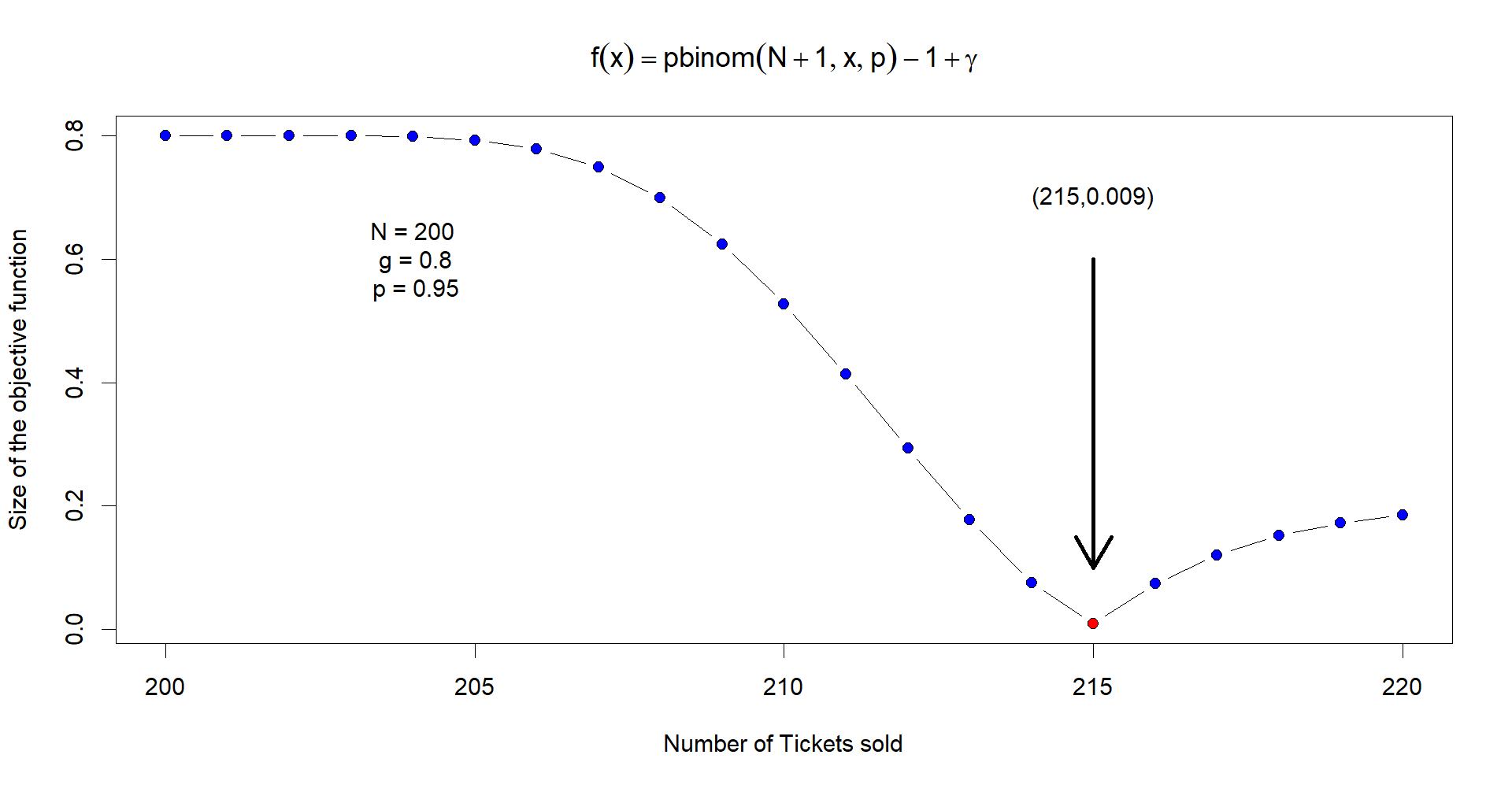
Lab 5 content
Generating a Random sample
Suppose that there is a bag of 20 marbles, 12 white (“1”) and 8 black “0”. Using the sample() function create a sample of size n=5 without replacement
sample(c(rep(0,12), rep(1,8)),size=5, replace=FALSE)
#where c is some array, rep(int,repeat_x_many_times)
#size=n=#taken
#replace: should sampling be with replacement? (do I take out what I just took out of the sample space? True: False

# If we wanted to do a coin flip:
sample(c("H","T"),size=10,prob=c(1/2,1/2),replace=TRUE)
sample(c(1,0),size=10,prob=c(1/2,1/2), replace=TRUE)
Binomial Experiment
Simulate a binomial experiment n=10,p=0.7, and Y=number of successes.
a <- c(100, 200, 500,1000,10000)#iteratiomns
for(i in a){
  print(  mybin(iter=i,n=18, p=0.3)  )#binomial expirment
}
Formula to code
Pois calculation
1 - ppois(q = 3, lambda = 2)Advanced choose
choose (10 - 1, 3-1) * 0.4 ^3 * 0.6 ^ (10-3)Advance pbinom
pbinom(q = 8, size = 15, prob = 0.4)Stuff on midterm
- Bernouli
- Testing problem??