Basic Concepts
-
Confidentiality
- Protect information access, only being exposed to users who should have access.
-
Integrity
- Assurance that information hasn’t been modified, or if it has, an audit is kept with what is changed
-
Availability:
- Information can be reached at all times with the right keys. Eg. information queried is always available (no DDOS attacks preventing queries from reaching the server).
-
Difference between cryptography/steganography
- Cryptography conceals contents, Steganography concerns existence
- symmetric: Dependent on one key to encrypt/decrypt (one time pad)
- asymmetric: Private/public key TLS handshake, slower
-
DoS attacks? - Rating/flow limiting Attack identification and elimination
Symmetric Crypto
- Block ciphers
- DES (Data Encryption Standard)
- 56 bit key, not fit for modern security (every 8th bit parity bit)
- Can be brute forced
- Double/Triple-DES: Apply DES multiple times
- AES (Advanced Encryption Standard)
- Longer key sizes + safer + faster than DES
| Step | Description |
|---|---|
| Key Expansion | Derives round keys from the main key |
| AddRoundKey | XORs state with round key |
| SubBytes | Byte substitution using S-Box |
| ShiftRows | Row shifting for diffusion |
| MixColumns | Column transformation for mixing (except last round) |
| Final AddRoundKey | XORs with final round key |
Modes of Operations?
SALT: Random piece of data that’s added to a password before it’s hashed
ECB (Electronic Code Book)
- Rarely recommended. Can be used for encrypting very short, random data where patterns don’t matter (e.g., one-time authentication tokens).
- Weakness against replay and frequency analysis attacks. Use: Pattern (repeating patterns)/Dictionary (set of possible plaintext known?)
- Splits plaintext into fixed-size blocks and encrypts each block independently using the same key.
- No chaining between blocks.
CBC (Cipher Block Chaining)
- Good for encrypting large files and data transmissions (e.g., disk encryption, databases). Avoid in real-time or performance-critical applications due to lack of parallelism.
- Weakness Bit Flip: attacker can flip specific bits in a ciphertext block to manipulate the decrypted plaintext
- Each plaintext block is XOR’d with the previous ciphertext block before encryption.
CFB (Cipher Feedback)
- Used for encrypting streaming data (e.g., network traffic, real-time audio/video encryption).
- Uses a shift register and encrypts an IV first, then XORs it with the plaintext to generate ciphertext.
- Weakness Bit Flip again
CTR (Counter)
- Best for high-speed applications like VPNs, disk encryption, and performance-sensitive environments.
- Uses a counter value that is encrypted, then XOR’d with the plaintext to produce ciphertext.
- Counter is incremented for each block.
- Weakness Bit Flip again
Hash Func?
- Properties (See assignment 2)
| Algorithm | Output Size | Security | Speed | Common Uses |
|---|---|---|---|---|
| MD5 | 128-bit | ❌ Weak | ⚡ Fast | Legacy checksums, non-security uses |
| SHA-1 | 160-bit | ❌ Broken | 🔸 Moderate | Legacy systems, Git hashing |
| SHA-256 | 256-bit | ✅ Secure | 🐢 Slower than MD5/SHA-1 | Cryptography, digital signatures |
-
Password Storage
-
File Authentication
-
Commitment Protocols
-
HMAC
-
Apps of hash func?
- Message authentication: HMAC vs CBC-MAC
- Message integrity check
- Password with salt (what is salt?)
- Commitment protocols
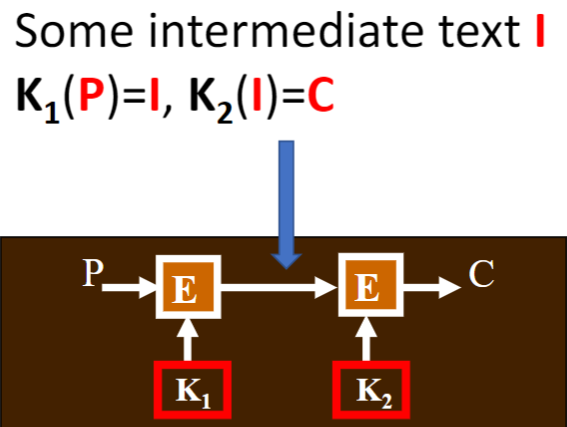
Meet-in-the-middle attack?
- attacker constructs patterns that propagate from both ends to the middle of the cipher, in some cases by partial key-guessing
| Feature | DSA (Digital Signature Algorithm) | RSA (Rivest-Shamir-Adleman) |
|---|---|---|
| Algorithm Type | Signature-only algorithm | Supports both encryption & signatures |
| Key Length | Typically 1024, 2048, or 3072 bits | Typically 2048 or 4096 bits |
| Security | Secure with strong hash functions | Secure but requires larger key sizes for same security level |
| Speed (Signing) | Faster | Slower |
| Speed (Verification) | Slower | Faster |
| Key Generation | Faster | Slower |
| Mathematical Basis | Based on modular exponentiation & discrete logarithm problem | Based on integer factorization problem |
| Usage | Digital signatures (not encryption) | Encryption, digital signatures, and key exchange |
| Common Applications | Government & FIPS-compliant digital signatures | SSL/TLS, PGP, SSH, and digital certificates |
| Standardization | FIPS 186-4 (NIST Standard) | PKCS#1 (RFC 8017) |
P & NP
Basically time takes to break vs verify
- P: the set of questions that can be solved in polynomial time
- NP: the set of questions for which an answer can be verified in polynomial time
if P=NP we could efficiently find the key without knowing it beforehand (all encryption broken!)