https://tutorial.math.lamar.edu/Classes/CalcIII/IteratedIntegrals.aspx
Fubini’s Theorem
If is continuous on ( then,
- These integrals are called iterated integrals
- Where [0,1] is the x-bound, and [0,2] y-bound.
- 2 ways 2 compute (x and y can be either first or last with matching bounds)
- Note how we first compute the inner integral first, then move onto the outer one.
Steps to Solve
- Compute the inner integral given the requested bounds, treating other var as a constant
- Compute outer region with requested bounds
Shortening Fact
If and we are integrating over the rectangle then,
- Estmpsentially, if we have … we can js integrate both separately
Regions between to curves:
We can have:
- Opposite facing parabolas
- Let region between
- Then, draw R, and find the max/min/fixed x&y slices and intersections
- Drawing A we simply take the region between both curves
- Part B: We setup a SoE:
- To find the max, see its at 0, the min is at
- max: 1.25
- 2 parabolas
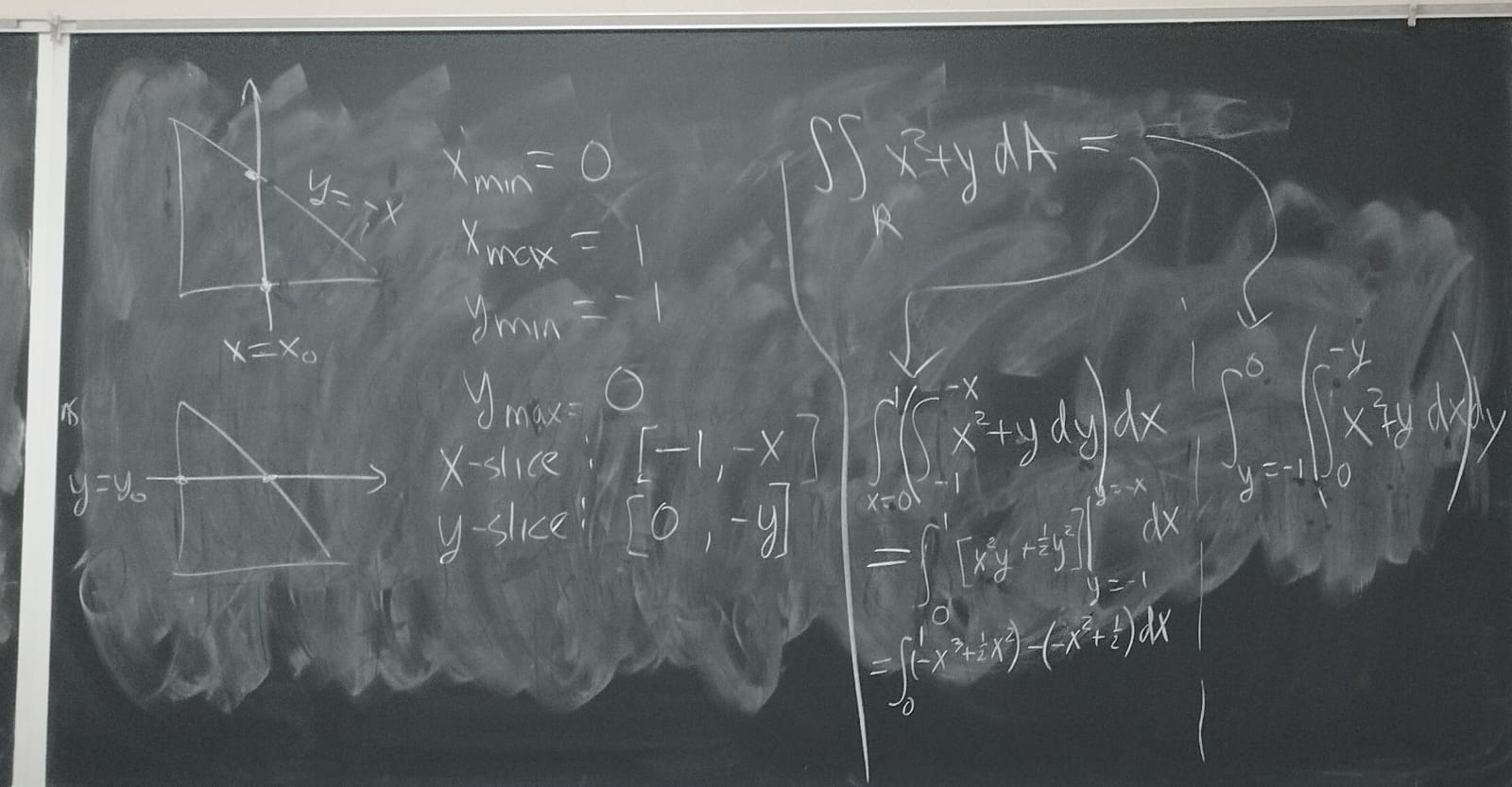
- Triangles
Q1, Triangle double \int
Then we want to graph, find bounds + xy min+max Then we integrate. We start given a set of points
Bounds (called slices in this case)